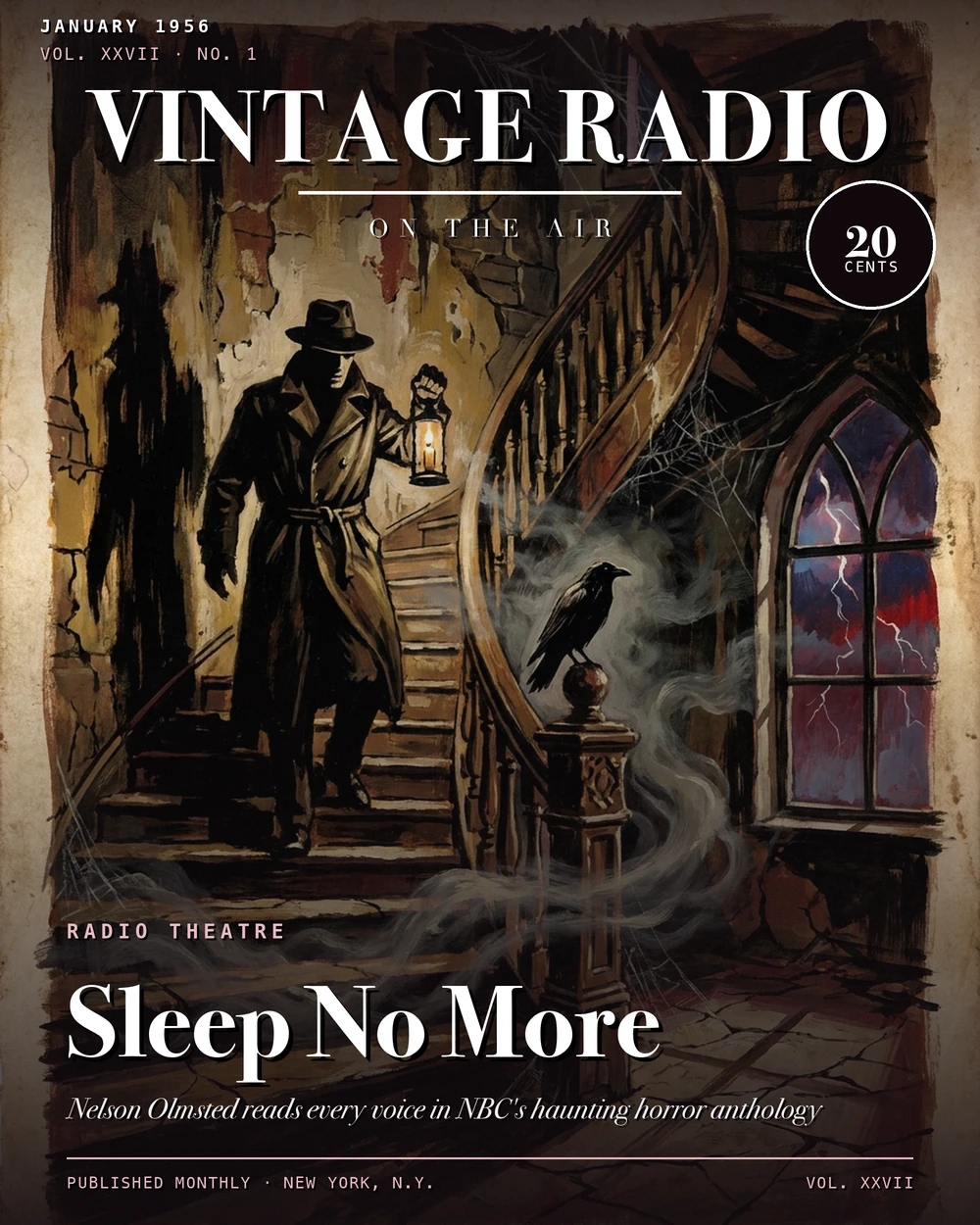
Sleep No More
One Man, Every Voice
The unusual thing about Sleep No More wasn't its subject matter — NBC had run dark anthology programming before. What set it apart was the performance format. Nelson Olmsted, born Leroy Nelson Olmsted Jr. in Minneapolis in 1914, stepped in front of a microphone and read every character himself. No full cast, no ensemble of players dividing up the roles. Just Olmsted moving between voices, letting background music and sound effects carry the atmosphere, presenting what he described as "good literature, read aloud." It was an intimate, almost theatrical approach that suited the material — largely horror, Gothic fiction, supernatural encounters, and science-fantasy drawn from published short stories — far better than a conventional dramatic cast would have.
The series ran on NBC as a sustained program, meaning it carried no sponsor, from November 21, 1956, through April 24, 1957. Ben Grauer handled announcing duties, introducing each broadcast. Kenneth MacGregor directed. Each half-hour episode typically presented two adapted stories, occasionally three, and the eleven episodes in the known 30-minute catalog represent only part of the show's life. Sleep No More had run earlier in a 15-minute format, and the Science Fiction Encyclopedia puts the total episode count at 24 across both runs, with somewhere between 19 and 26 episodes surviving.
Where the Stories Came From
The literary range Olmsted pulled from was considerable. Episodes drew on Ambrose Bierce, Algernon Blackwood, Jack London, Edgar Allan Poe, H. G. Wells, John Collier, Cornell Woolrich (writing under the name William Irish), Nelson S. Bond, and others. Several source stories are confirmed from surviving episodes: H. G. Wells's 1894 tale "The Flowering of the Strange Orchid" supplied one episode title almost verbatim; George G. Toudouze's "Three Skeleton Key" — about men besieged by rats in a lighthouse — became another; Cornell Woolrich's tense "Three O'Clock" appears in the catalog; John Collier's dark comic "Thus I Refute Beelzy" turns up as well; Irvin S. Cobb's unsettling "Fishhead" is represented; and Nelson S. Bond's "Conqueror's Isle" rounds out the confirmed list.
The episode titles in the catalog reflect the paired-story format clearly. "To Build A Fire and Three Skeleton Key" puts a Jack London survival story alongside the rat-siege horror. "The Wax Work and The Man and The Snake" pairs a tale from the waxwork-murder tradition with a piece of Gothic naturalism. "Thus I Refute Beelzy and The Book Shop" sets Collier alongside something quieter. The pairings weren't random — Olmsted was working as a careful anthologist, and the half-hour structure pushed him toward stories that could be condensed and performed in roughly ten to fifteen minutes each without losing their core effect.
Calling the series Crime-Detective, as it has sometimes been catalogued, fits only a fraction of what it actually presented. Multiple sources — including the Science Fiction Encyclopedia — classify it as a horror, thriller, and science-fantasy anthology. Crime and suspense elements do appear across the episodes, but the bulk of the material is supernatural horror, Gothic fiction, and SF premises. There is no recurring detective figure, no central investigator across episodes. Olmsted is the only constant — narrator and performer in every broadcast, the sole human voice bringing each different set of characters to life.
Olmsted's Long Road to NBC
Sleep No More wasn't the first time Olmsted had built a show around this concept. His radio career started at WBAP in Fort Worth, Texas, where he developed the habit of reading classic short fiction aloud on air. In 1937 he launched Black Night, a local Fort Worth horror-reading series that ran through 1939 — his first experiment with the format that Sleep No More later refined. By 1940 the storytelling approach had moved to NBC, where Olmsted ran the concept for roughly a decade under titles including The World's Greatest Short Stories. He had been doing this, in various forms, for the better part of two decades by the time Sleep No More premiered.
That background explains why the solo-reading format didn't feel like a shortcut. For Olmsted, it was the point. He had built his reputation on the idea that a single skilled performer, working with carefully chosen prose and the right sound design, could generate as much tension and atmosphere as a full cast. The moody music and sound effects that accompanied each episode weren't decoration — they were structural, filling the silences that would otherwise signal the absence of other actors, and sustaining the mood between the rapid vocal character shifts Olmsted made within a single story.
In 1956, the same year the expanded Sleep No More launched on NBC, Olmsted also recorded a Vanguard Records LP — Sleep No More! Famous Ghost and Horror Stories (VRS 9008) — featuring six readings with sound effects. It was later paired with Edgar Allan Poe: Tales of Terror (VRS 9007) in a reissued two-record set. The LP suggests Olmsted and his collaborators understood they were doing something with lasting value, something worth preserving in a form beyond the broadcast schedule.
The End of the Run
The series ended April 24, 1957. It had aired for roughly five months in its 30-minute form, sustained by NBC without commercial backing — a format that gave it creative freedom but also made it vulnerable to schedule pressures. By the mid-1950s, network radio drama was losing ground to television steadily, and an unsponsored anthology built around a single performer wasn't positioned to resist that tide. Sleep No More has been described as one of the last horror anthology programs on NBC radio, arriving near the end of the period when the network had any appetite for that kind of sustained dramatic programming.
Olmsted outlived the show by several decades, dying in Torrance, California, in April 1992 at age 78. The series he built around solo literary readings — tracing back through The World's Greatest Short Stories and Black Night all the way to his WBAP days in the 1930s — stands as an unusual throughline in American radio drama: one man's persistent argument that the short story, read aloud with skill and a decent sound budget, was a format worth taking seriously.